


For a minute there, it felt like the “pre-buy” conversation had gone quiet. Regulations were shifting; there were speculations about what the EPA was going to do next, and many in the industry thought the urgency to secure build slots faded. But behind the scenes, companies were still watching and waiting for a final answer.
Now it’s official, the EPA is holding firm on their 2027 NOx Rule. The EPA will move forward with their 2027 timeline, and the 2027 NOx standard is staying at 35 mg. The EPA's adjustment proposal won't be released until spring of 2026 so fleets will have less time to secure 2026 build slots once 2027 pricing is released by OEMs, which re-introduces the risk of going back to a strict allocation environment. This has made the industry snap right back into planning mode.
Companies are already moving up their orders earlier than expected, because calendar years 2025 and 2026 are officially the last comfortable landing zones before everything changes. However, Q3 and Q4 of 2026 are already selling out.
Once Model Year 2028 hits on January 1st, 2027, the rules change. Engines need to meet the tight 35 mg NOx limit, new warranty requirements, added emissions components, and the GHG Phase 3 updates. These changes all come with a significant cost increase. Most forecasts pertaining to Class 8 tractor costs show once the technology becomes standard there will be a significant cost increase between $8,000–$15,000 per truck.
What OEMs Are Telling Us About CY 2026 - Confirming that 2026 is not the year to wait and see what happens!
- PACCAR MX engines for 2026 will be certified for all 50 states with updated warranties.
- Some Cummins engines won’t work in CARB states, so fleets need to confirm where the truck will be registered before placing an order.
- There’s no price protection on orders sitting in the backlog, engines may be updated to whatever certification year is installed at build time.
- Certification differences (CARB vs. EPA) may change pricing or availability.
CURRENT PRE-BUY Timeline Fleets Should Be Planning Around
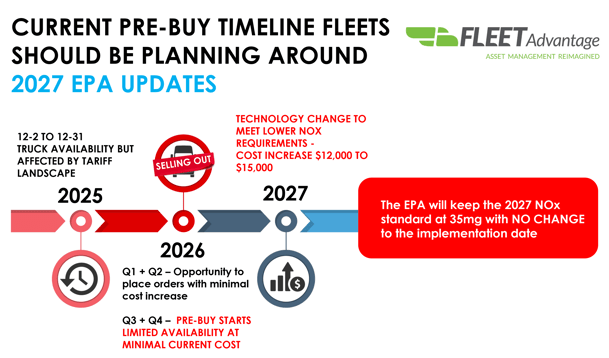 Now - December 30, 2025: This is the best time to place your orders. Availability is good, but costs may still be affected by other market conditions as the year goes on.
- Q1 - Q2 2026: There is still availability to place orders with minimal cost increase, but things will start tightening. Industry analysts already see fleets pulling orders forward because they don’t want to gamble on limited slots.
- Q3 - Q4 2026: The EPA will release their adjustment proposal. Consider this the “last call” as build slots are already selling out for this timeframe. There will be limited availability at minimal current cost.
- 2027: No more waiting! The new standard hits.
OEMs shift to 2027 engines, and the price increase becomes very real, increasing from $8,000 - $15,000.
Why Private Fleets Are Moving First
Private fleets feel these cost shifts faster because they budget on multiyear cycles. They know exactly what $8,000–$15,000 per truck does to their bottom line.
That’s why they are already:
- Mapping out NOW what to replace in 2026 and 2027
- Securing build slots before they vanish
- Double-checking registration requirements
- Protecting budgets from a sharp price increase
Waiting until “later” almost always pushes fleets straight into the higher-cost window. The pre-buy never really went away; everyone was just waiting for clarity. Now we have it. The EPA is moving forward, OEMs are preparing, and organizations that want to stay ahead are already locking in 2026.
If the goal is to control costs, secure availability, and avoid the 2027 price jump, the smartest step is to plan now!